
6G vs 5G: How Connectivity Will Evolve in 2026
Mobile network technology is evolving faster than ever. After the global rollout of 5G, the world is already preparing for the next big leap: 6G. In 2026, both 5G and early-stage 6G technologies will shape how people connect, communicate, and use digital services. Understanding the difference between 5G and 6G is important for businesses, tech enthusiasts, and everyday users.
This article explains what 5G and 6G are, how they differ, and how connectivity will evolve in 2026.
What Is 5G Technology?
5G, or fifth-generation wireless technology, is currently the most advanced commercial mobile network. It offers faster internet speeds, lower latency, and better connectivity compared to 4G. 5G enables smooth video streaming, online gaming, video calls, and supports technologies like smart cities and autonomous vehicles.
By 2026, 5G will be widely available in most countries, with improved infrastructure and coverage. Many industries already rely on 5G for automation, healthcare systems, and Internet of Things devices.
What Is 6G Technology?
6G, or sixth-generation wireless technology, is the future of mobile connectivity. While it is still in the research and testing phase, 6G is expected to go beyond speed and focus on intelligence, real-time communication, and immersive digital experiences.
6G aims to integrate artificial intelligence directly into networks, enabling smarter and more adaptive connectivity. In 2026, 6G will not be fully commercial, but early trials and pilot projects will begin influencing technology development.
Speed Comparison Between 5G and 6G
Speed is one of the biggest differences between 5G and 6G. 5G already offers download speeds up to several gigabits per second. This is a huge improvement over previous generations and supports high-quality content and real-time communication.
6G is expected to be much faster, potentially reaching terabit-level speeds. This means downloading large files in seconds and enabling instant data transfer. In 2026, 5G will still be the dominant technology, but 6G research will set new expectations for ultra-fast connectivity.
Latency and Real-Time Communication
Latency refers to the delay between sending and receiving data. 5G significantly reduces latency compared to 4G, making real-time applications like online gaming and remote surgery possible.
6G aims to reduce latency even further, approaching near-zero delay. This will enable real-time virtual environments, advanced robotics, and immersive experiences like holographic communication. By 2026, 5G will support most real-time needs, while 6G development will push boundaries further.
Role of Artificial Intelligence in 6G
One major difference between 5G and 6G is the role of artificial intelligence. While 5G supports AI applications, 6G is expected to be AI-native. This means AI will be built into the network itself.
6G networks will use AI to manage traffic, improve security, and optimize performance automatically. In 2026, this concept will still be developing, but it will influence how future networks are designed and managed.
Connectivity and Device Ecosystem
5G supports a wide range of devices, including smartphones, smart homes, industrial machines, and IoT sensors. It allows multiple devices to connect simultaneously without performance issues.
6G will expand this ecosystem further by connecting everything, including wearables, smart cities, autonomous systems, and extended reality devices. In 2026, most users will still rely on 5G devices, but manufacturers will begin preparing for 6G-compatible technology.
Impact on Industries in 2026
In 2026, 5G will continue transforming industries such as healthcare, manufacturing, transportation, and entertainment. Remote medical procedures, smart factories, and autonomous vehicles will rely heavily on stable 5G networks.
6G, although not fully launched, will influence long-term industry planning. Companies will invest in research and infrastructure to prepare for future capabilities like fully immersive virtual worlds and advanced automation.
Security and Privacy Differences
Security is a key concern in modern connectivity. 5G includes advanced security features compared to older networks, but it still faces challenges like cyber threats and data privacy issues.
6G aims to improve security using AI-based threat detection and encryption methods. These features will help create safer networks. In 2026, security improvements in 5G will continue, while 6G research will focus on building trust and resilience from the start.
Energy Efficiency and Sustainability
Energy efficiency is becoming more important as networks expand. 5G networks are more energy-efficient than 4G, but they still require significant power for infrastructure.
6G is expected to focus strongly on sustainability. It aims to reduce energy consumption and use smart resource management. By 2026, sustainability will be a key factor in network planning, influencing both 5G upgrades and 6G research.
Availability and Adoption Timeline
By 2026, 5G will be fully integrated into daily life in many regions. Smartphones, homes, and businesses will depend on 5G connectivity.
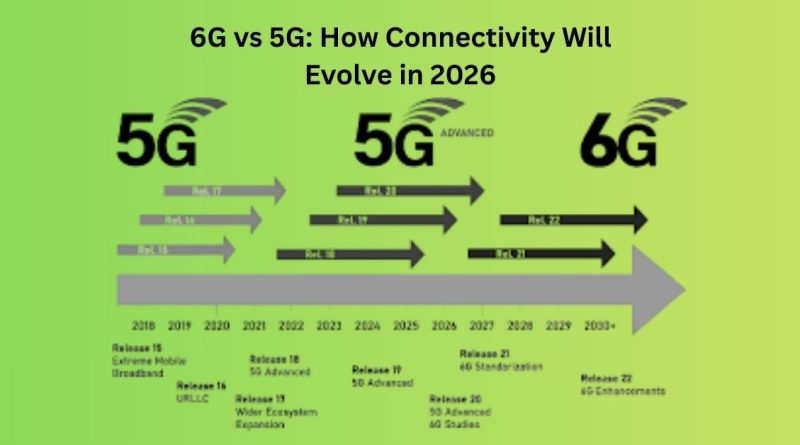
6G, on the other hand, will still be in early development stages. Large-scale adoption is expected after 2030. However, discussions, trials, and standards development in 2026 will shape how quickly 6G becomes reality.
6G vs 5G: Which One Matters More in 2026
In 2026, 5G is the technology that matters most for consumers and businesses. It will power most digital experiences and innovations. 6G is important for the future, but it will not replace 5G immediately.
Understanding 6G helps users and organizations prepare for upcoming changes, while focusing on 5G ensures they benefit from current capabilities.
Conclusion
The comparison between 6G and 5G shows how connectivity will evolve in 2026. 5G will remain the backbone of modern communication, supporting faster speeds, low latency, and wide device connectivity. 6G represents the next step, promising intelligent, ultra-fast, and immersive networks.
As technology continues to advance, staying informed about both 5G and 6G helps individuals and businesses make better decisions. In 2026, the evolution of connectivity will be driven by innovation, preparation, and a vision for a more connected future.
FAQs
What is the main difference between 5G and 6G?
The main difference is speed and intelligence. 5G focuses on faster internet and low latency, while 6G aims to integrate artificial intelligence for smarter and real-time connectivity.
Will 6G replace 5G in 2026?
No, 6G will not replace 5G in 2026. 5G will remain the primary network, while 6G will be in research and early testing stages.
How fast will 6G be compared to 5G?
6G is expected to be much faster than 5G, potentially offering terabit-level speeds, while 5G provides gigabit-level speeds.
Is 6G available for consumers in 2026?
No, 6G will not be commercially available in 2026. Large-scale consumer adoption is expected after 2030.
Why is 6G important for the future?
6G is important because it will enable advanced technologies like holographic communication, immersive virtual experiences, and intelligent network management.